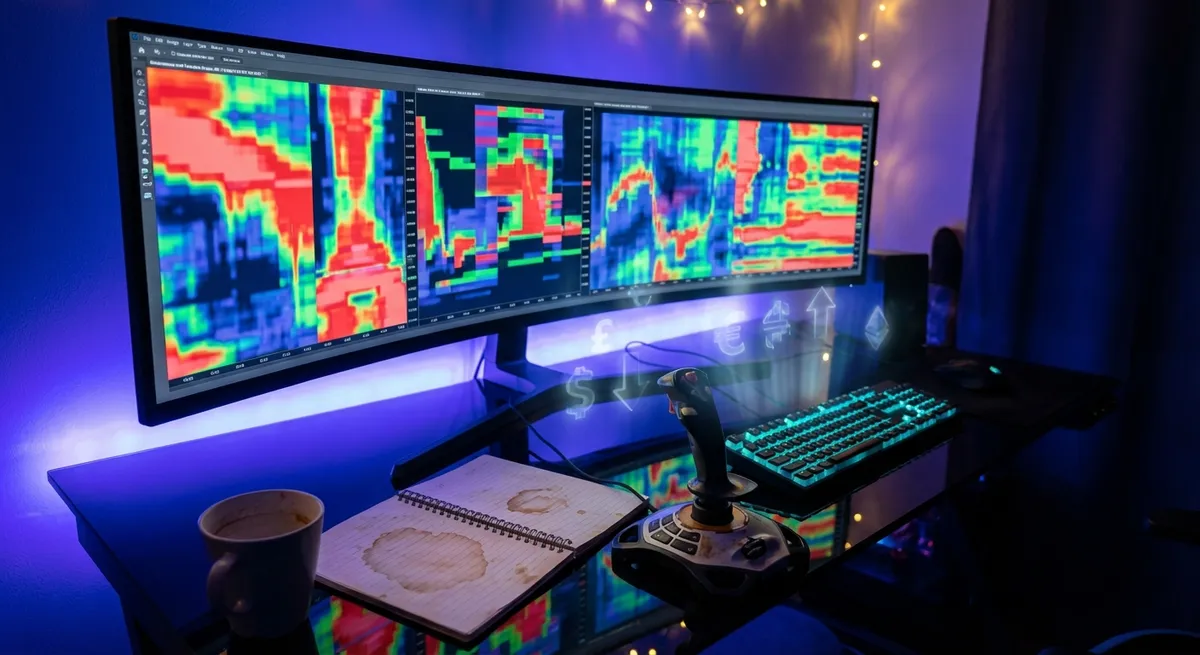
If your charts still look like they did in 2018, you’re leaving edge on the table. The new wave of trading tools isn’t about adding more indicators—it’s about stripping noise, automating the boring stuff, and letting you move faster when the market snaps. This is the trading stack traders are actually flexing in private chats, not just posting on the ‘Gram.
Let’s break down the five tool trends turning ordinary FX setups into high‑signal, low‑stress trading environments.
1. Smart Order Flow Dashboards: Seeing the Moves Before the Move
Order flow used to be something only the big desks talked about. Now, retail traders are plugging into lighter, faster versions that reveal who might be pushing price and where the real liquidity is hiding.
Modern order flow dashboards combine things like depth-of-market snapshots, volume clusters, and key liquidity zones into one clean interface. Instead of staring at a dozen timeframes, you get a real-time feel for absorption, stop runs, and where price might whip next. Traders are sharing clips of how a single liquidity pocket lined up with their bias and gave them a sniper entry—no messy indicator soup, just raw flow.
The real power here is anticipation. When you see liquidity stacking above a recent high or below a key low, you’re not surprised by the spike; you’re ready to either fade it, ride it, or get out of the way. If you’ve ever been wicked out right before the “real” move, this is the kind of tool that flips the script.
2. AI-Powered Journal Assistants: Turning Your Trades Into Data Gold
The era of “I’ll remember what I did” is over. The traders leveling up right now are using AI-driven journals that track every entry, exit, tweak, and tilt—then actually tell them what’s working.
These tools auto-import your trades, tag setups, attach chart screenshots, and run analytics on your behavior. But the viral twist is the AI layer: natural language summaries of your week, notes like “You trade best in London open after a higher-timeframe break of structure,” or “You keep revenge-trading after your first loss of the day.” This isn’t just stats—it’s pattern recognition on you.
Screenshots of “before vs. after” performance using these journals are circulating everywhere: same strategy, but smarter execution thanks to real feedback. When your own data shows that your win rate spikes when you skip Mondays or avoid news spikes, it stops being a guess and starts being a rule you can actually stick to.
3. Automation Lite: Click-Simple Tools That Don’t Kill Your Edge
Full-blown algos aren’t for everyone, but “automation lite” is exploding—tools that automate the process while leaving the decision to you.
Think smart trade managers that instantly set pre-defined stop-loss, partials, and break-even moves with one click. Or conditional orders you can stack in advance: “If London high breaks by X pips with spread under Y, place this limit order with these rules.” You’re still the strategist, but the tool handles the execution with zero hesitation and no fat-finger entries.
This is what traders love sharing: side-by-side charts of how their old manual trade management left money on the table versus their new semi-automated approach that locked in partials precisely where they planned. The key trend? More control, less micro-managing. Automation is no longer about letting a robot trade for you—it’s about never missing the plan you already built.
4. Multi-Asset Correlation Monitors: FX Traders Thinking Like Macro Funds
The sharpest FX traders are no longer staring only at EURUSD or XAUUSD. They’re running correlation dashboards that track bonds, equity indices, commodities, and even crypto to frame their currency bias.
These tools visualize relationships: how USD pairs are reacting to yields, how risk-on vs. risk-off is reflected in JPY and CHF, or how commodities are steering AUD, CAD, and NZD. Instead of randomly shorting a pair that “looks overextended,” traders are syncing their plays with macro flows: “If the S&P dumps and yields spike, this is what I expect USDJPY to do.”
What’s share-worthy is how clean the narrative becomes. Traders post snapshots like: “Yields up, dollar index breaking, risk assets off—no surprise EURUSD rolled.” When your FX trades are backed by a macro dashboard instead of a single chart pattern, you start thinking like a desk, not just a screen warrior.
5. Latency-Savvy Execution Tools: Tight Spreads Aren’t the Whole Story
Everyone loves to argue spreads, but the new flex is execution quality. Traders are paying attention to how fast orders are filled, how often they get slipped, and what that actually costs them over hundreds of trades.
Modern execution tools and analytics plug directly into your platform and track fill speed, slippage per instrument, and performance by session and broker server. This lets traders benchmark their environment instead of guessing. Some are even using VPS setups or broker-specific bridges to shave milliseconds—and when you’re scalping or trading news, that gap is real money.
What’s getting shared is brutal but honest: same strategy, same pair, but better fills show a clear lift in performance. Once you see your scalps bleed out due to slippage and delay, a “good-enough” setup stops being good enough. Tight spreads are the headline; execution analytics are the fine print that actually decides your P&L.
Conclusion
The tools that matter in FX right now aren’t the flashiest—they’re the ones quietly compressing your learning curve and hardening your edge.
Smart order flow dashboards help you read the crowd, AI journals decode your own habits, automation lite keeps you loyal to your plan, macro correlation boards upgrade your narrative, and execution analytics protect your edge where it actually counts: at the ticket.
You don’t need every tool on the shelf. But if your trading setup today looks exactly like it did three years ago, the market has evolved without you. Pick one of these trends, plug in a tool that fits your style, and let your results—not the hype—decide what stays in your stack.
Sources
- Bank for International Settlements – Triennial FX Survey - Data on the size, structure, and evolution of the global foreign exchange market
- CFTC – Commitments of Traders (COT) Reports - Insight into positioning of major trader groups in futures and options markets
- Investopedia – Order Flow Analysis - Overview of how order flow trading works and why it matters for price action
- CME Group – FX Products & Research - Information on FX futures, options, liquidity, and market structure from a major exchange
- New York Fed – The Foreign Exchange and Interest Rate Derivatives Markets - Research on how FX markets function and how trading has evolved over time
Key Takeaway
The most important thing to remember from this article is that this information can change how you think about Trading Tools.