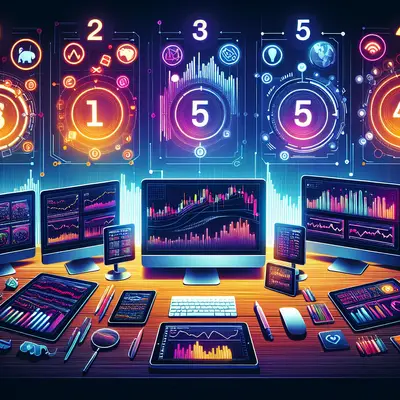
If your trading screen still looks like a 2012 MT4 meme, you’re leaving edge on the table. Today’s forex pros aren’t just “watching charts” — they’re building mini command centers powered by smart tools, automation, and data streams that move faster than the headlines.
This isn’t about downloading 50 random indicators and hoping for the best. It’s about stacking a tight lineup of tools that turn market chaos into clean, confident decisions — the kind you actually want to screenshot and share.
Let’s break down five trending trading-tool moves the FX crowd is quietly upgrading to right now.
1. Smart Order Flow Dashboards: Seeing the Crowd Before It Moves
Order flow tools used to be reserved for prop desks and hedge funds. Not anymore. Modern platforms are visualizing liquidity, volume, and trade imbalances in ways that feel more like heatmaps than spreadsheets — and FX traders are obsessed.
Instead of just marking up support and resistance, traders are now watching where orders actually cluster: who’s trapped, who’s in control, and where liquidity is thin. Depth-of-market (DOM), volume profile, and footprint-style views are becoming go-to filters before pulling the trigger.
Here’s the real power move: combining traditional chart levels with live order flow. A level backed by obvious absorption or aggressive buying/selling suddenly hits different — it’s not just a line anymore, it’s a battlefield.
Smart traders are also using order flow tools as a risk throttle: if liquidity is thin and spreads are jumpy, they size down or stay flat. When liquidity is thick and volume aligns with their bias, they press harder. That shift from “hope the level holds” to “watch how the market defends it” is what’s quietly separating button-clickers from actual operators.
2. AI-Powered FX Dashboards: From Data Avalanche to One-Glance Clarity
Most traders drown in information because they track everything and prioritize nothing. AI dashboards are flipping that. Instead of opening 12 tabs, traders are consolidating news, macro data, sentiment, and chart states into a single, prioritized view.
Think:
- Auto-tagged news by currency impact and urgency
- Headline summaries without needing to read full articles
- Instant mapping of which currencies a macro release actually hits
- Basic pattern and volatility detection baked into your chart layout
The goal isn’t to let AI trade for you — it’s to outsource the grunt work: scanning, sorting, and surfacing what matters now. Traders are increasingly using these dashboards to build a daily “playbook scan”:
Which pairs have fresh catalysts?
Which are sitting at key weekly or daily levels?
Where is volatility expanding or compressing?
Instead of scrolling through noise, they’re opening the day with a ranked list of opportunities. That alone can be the difference between chasing setups and calmly executing a plan.
3. Automation Lite: No-Code FX Bots That Execute Your Rules (Not Your Feelings)
Full algo trading can feel intimidating — code, backtesting, infrastructure, the whole thing. But there’s a huge middle ground that’s exploding in popularity: automation lite.
No-code and low-code tools are letting traders:
- Auto-place bracket orders (entry, stop, and target) the moment price tags a predefined level
- Trigger alerts or partial closes at specific risk multiples (e.g., at 1R, 2R)
- Auto-log every trade into a journal the second it’s opened or closed
- Enforce max daily loss or “lockout” rules so tilt-trading doesn’t nuke the account
The vibe here isn’t “let the bot decide.” It’s “let the bot enforce what I already decided when I was calm.”
Traders are building workflows like:
If price reaches this kill zone and spreads are under X and it’s not five minutes before news → place a pending order with predefined risk.
Once that’s live, your FOMO has less power. You don’t have to chase entries because the automation already has your back. And when your journal fills itself, pattern-spotting in your own behavior gets way easier.
4. Pro-Grade Journaling & Analytics: Turning Every Trade Into a Data-Backed Upgrade
If your trading journal is still a random Excel file you update “when you remember,” you’re missing the upgrade moment every serious trader is talking about.
Modern journaling tools are doing way more than storing screenshots and P/L:
- Auto-tagging trades by pair, session, strategy, and direction
- Breaking down which setups actually pay and which are just vibes
- Showing win rates, average R, and max drawdown per strategy, not just per account
- Surfacing time-of-day and day-of-week performance so you can cut low-quality hours
The win isn’t just nice charts. It’s the clarity. Traders are using these tools to:
- Kill underperforming setups ruthlessly
- Double down on their top two or three high-conviction structures
- See how slippage, spread, and news events quietly mess with results
Over time, your trading stops being “I think this works” and starts becoming “This edge has a 53% win rate at 1.8R average with a tolerable drawdown profile.” That’s the language professional risk is spoken in — and journaling tools are translating for everyday traders.
5. Multi-Screen, Single-Brain: Syncing Mobile, Desktop & Web Into One FX HQ
The days of being chained to a single trading PC are fading fast. Traders are building synchronized trading ecosystems across devices so they can monitor everywhere but only execute where it’s safest and cleanest.
The new-school setup often looks like this:
- Desktop or laptop: main execution hub with full charting + order flow + risk controls
- Tablet: clean higher-timeframe charts only, to avoid getting lost in 1-minute noise
- Phone: alerts only — price tagging key zones, news breaks, or session opens
The key is sync. Watchlists, layouts, alerts, and templates are mirrored across platforms, so you’re never guessing what you were waiting for on your main screen.
This structure solves two problems at once:
- You’re in the loop during key moments without revenge-trading from your phone.
- You protect your focus — deep work at the desk, light monitoring on the go.
For traders who also work day jobs or move around a lot, this “multi-screen, single-brain” toolkit turns inconsistency from an excuse into a solved problem.
Conclusion
Trading tools aren’t magic — they’re multipliers. If your process is chaos, tools will just scale your chaos. But if you’re even half-serious about structure, risk, and edge, the right stack can turn your trading from improv to performance.
Order flow dashboards show you where the real battles are. AI dashboards cut through information overload. Automation lite enforces your best self. Pro journaling tells you what actually works. Multi-device sync lets you stay connected without losing control.
You don’t need every tool on the market. You just need a coherent lineup that matches how you trade, how you think, and how you want to grow. Start with one upgrade, integrate it fully, then stack the next.
In a market this fast, “just clicking buy and sell” is already outdated. The edge now is simple: build a smarter cockpit — and then fly it with discipline.
Sources
- Bank for International Settlements – Triennial Survey of FX Turnover – Official data on global FX trading volumes and market structure
- CFTC – Risk Management in Trading – Guidance on risk practices that modern trading tools can help enforce
- Investopedia – Order Flow Analysis Definition – Overview of order flow concepts and why traders use them
- CME Group – Understanding Market Depth – Explains market depth and order book tools that inspire retail FX equivalents
- Harvard Business Review – How to Make Better Decisions with Analytics – Broad look at data-driven decision making, relevant to journaling and performance analytics
Key Takeaway
The most important thing to remember from this article is that this information can change how you think about Trading Tools.